
The oldest known name of the settlement is Kuwalapassa. Over time, it was known by various names, including Anastasiopolis, Makri, and Meğri. The Lycian name of the city is Telebehi. Today, it is located in the center of the town of Fethiye in Muğla Province. It was the most important port settlement on the western border of Lycia, and the westernmost Lycian inscription has been found at Telmessos. Although it was not among the largest or most powerful cities of the Lycian League, in the 5th century BCE it was the largest contributor among the Lycian cities that supported the Athenian League. The city maintained its importance throughout all periods due to its strategic position overlooking the Glaukos Gulf and the fertile lands surrounding it. During the dynastic period, it came under the control of powerful regional dynasts such as Albinas and Perikle, and, following the death of Alexander, it passed under the rule of the Ptolemaic, Seleucid, and Pergamene kingdoms. Although Telmessos joined the Lycian League relatively late, in 80 BCE, it became one of the important cities of the League during the Roman period.
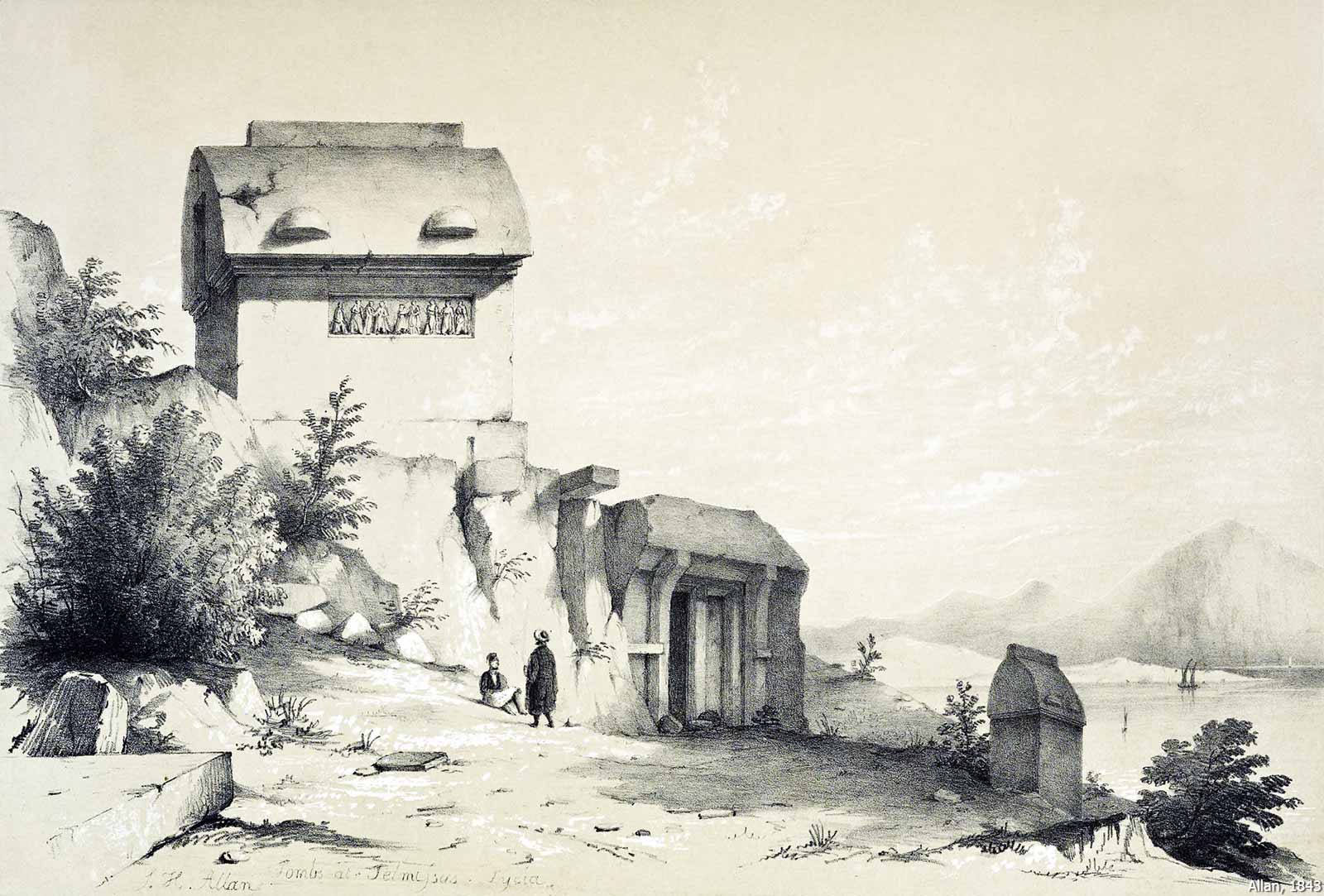
The earliest settlement of the city was located on two hills known as Hıdırlık (or Hızırlık). Tombs and remains of the city walls can still be seen on the acropolis of this early settlement. It is likely that the settlement shifted toward the seashore after the dynasts of Xanthos conquered the region in the 5th century BCE. By the Hellenistic period, Telmessos had developed into one of the largest and wealthiest port cities in the region. However, the ancient settlement around the harbor has largely been destroyed by modern construction. The most significant monuments that have survived to the present day are the rock-cut tombs located to the southeast of the castle hill. The most impressive among them is the tomb of Amyntas, which features an Ionic temple façade. In addition to a few temple-type tombs similar to that of Amyntas, there are numerous rock-cut tombs, most of which follow the classical Lycian house style and some of them bears Lycian inscriptions. The sarcophagi depicted in the drawings of 19th-century travelers are today situated among the buildings of the modern city. Most of the stones from the Telmessos theater, also recorded in these drawings, were reused in the construction of the Fethiye harbor in 1953. In 2012, restoration work began on the remains of the theater.




Telmessos Sarcophagus
When 19th-century travelers visited the city, this sarcophagus stood in the Fethiye harbor with its base submerged in water. Today, it stands next to the government office building within the modern urban area, although only the sarcophagus chest and lid are visible above ground; the podium and hyposorion remain buried. It is a typical Lycian sarcophagus of the dynastic period, characterized by architecture imitating a wooden house and an ogival-shaped lid. Both sides of the lid and the ridge beam are decorated with reliefs depicting battle scenes. The reliefs on both pediments of the lid likely represent the tomb owner and his family. Drawings by Fellows and Texier indicate that the podium of the tomb also once bore reliefs, which are no longer visible today as that part lies below ground level. Texier suggested that these reliefs may have been added during a later phase of reuse.


Amyntas Tomb Monument
This is the largest and most significant of the rock-cut tombs in Telmessos. The tomb features an 11 × 13 m façade with double columns and a triangular pediment, designed in the form of an Ionic temple. An inscription on the façade states that it was built for Amyntas, son of Hermapias. Most scholars date it to the second half of the 4th century BCE. Little is known about Amyntas; he may have been a local ruler or a wealthy member of the city’s elite. While the name Hermapias is Lycian, Amyntas is of Greek origin. It is known that the construction of temple-style tombs began in the pre-Alexander period. In contrast to the numerous classical Lycian-style tombs carved into the same rock faces, these temple-façade tombs likely reflect a cultural transformation influenced by Hellenistic traditions following the dominance of the Carian and Hecatomnid dynasties in the region.


References:
Akşit, O. 1967. Likya Tarihi, İstanbul Üniversitesi Edebiyat Fakültesi Yayınları No:1218, İstanbul.
Başgelen, N. (ed.) 2005. Lycian Journal 1892 – Ernst Krickl, Archaeology and Art Publication, İstanbul.
Benndorf, O. & G. Niemann. 1884. Reisen in Lykien und Karien (Reisen im südwestlichen Kleinasien I), Wien.
Borchhardt, J. 2016. “Lycian Dynasts and Temple Tombs,” in From Lukka to Lycia: The Land of Sarpedon and St. Nicholas, eds. H. İşkan & E. Dündar, 402–408, İstanbul
Çevik, N. 2021. Lykia Kitabı: Arkeolojisi, Tarihi ve Kültürüyle Batı Antalya, Türk Tarih Kurumu, Ankara.
Fellows, C. 1839. A Journal Written During an Excursion in Asia Minor, London.
Fellows, C. 1847. Introductory Remarks to Lycia, Caria, Lydia, London.
Greaves, A. M., S. Duffy, J. R. Peterson, Ş. R. Tekoğlu & A. Hirt. 2020. “Carved in Stone:Field Trials of V-RTI in Classical Telmessos,” Journal of Field Archaeology 45/7.
Petersen, E. & F. Von Luschan. 1889. Reisen in Lykien Milyas und Kibyratis. Reisen im Südwestlischen Kleinasien II, Wien.
Texier, C. 1849. Description de l’Asie Mineure, Vol.3, Paris.
Tietz, W. 2003. Der Golf von Fethiye. Politische, ethnische und kulturelle Strukturen einer Grenzregion vom Beginn der nachweisbaren Besiedlung bis in die römische Kaiserzeit, Bonn.
Wörle, M. 1980. “Telmessos in hellenistischer Zeit,” in Actes du Colloque sur la Lycie antique, Istanbul 1977, Paris, 63–72.
Images:
C. Fellows, 1839, 1841, 1847
J. H. Allan, 1843
C. Texier, 1849
O. Benndorf & G. Niemann. 1884
E. Petersen & F. von Luschan, 1889
F. W. Hasluck, 1909
SALT – Ali Saim Ülgen Archive, 1932
N. Başgelen, 2005
A. M. Greaves et al., 2020
Tayfun Bilgin, 2022
Reha Özer, 2022
Bora Bilgin, 2022, 2023, 2025