
The ruins of Oinoanda are located near the village of İncealiler in the Seydikemer district of Muğla. It was one of the four major cities of the Kibyratis (Kabalis) region, together with Kibyra, Balboura, and Bubon. Although the city has been associated with Wiyanawanda mentioned in Hittite inscriptions, this identification remains highly debated. According to inscriptions from the Hellenistic period, the city was founded by colonists from Termessos, a Pisidian city. For this reason, it is often referred to as Termessos near Oinoanda or Termessos Minor.
During the dynastic period, particularly under the rule of Perikle, it is thought that Oinoanda, along with Balboura and Bubon, lay within the borders of Lycia. However, due to conflicts with other Lycian cities, these four cities (Oinoanda, Kibyra, Bubon, and Balboura) formed a tetrapolis. This alliance came to an end after the defeat by Rome of the army of Mithridates, which had been supported by the tetrapolis. Following the dissolution of the alliance, Oinoanda, like the other member cities, joined the Lycian League in 81 BCE with two votes.
The city was established on a ridge between two mountains in a position favorable for defense. The earliest securely dated structure is the Hellenistic city wall, which dates to the 2nd century BCE. Most of the other architectural remains belong to the Roman period and later. In addition to several structures whose functions have been identified—such as two baths, a theater, an aqueduct, and a temple—numerous other building remains are present. Oinoanda was first identified in the modern era by R. Hoskyn and E. Forbes in 1841. The site is particularly rich in epigraphic material, the most significant of which is the inscription of Diogenes. Apart from epigraphic studies conducted since the 19th century, more systematic research at the site began in 1968 and has continued intermittently to the present. The only excavation carried out to date took place in 1997 in the monumental square known as the “esplanade,” where the Diogenes inscription was located.


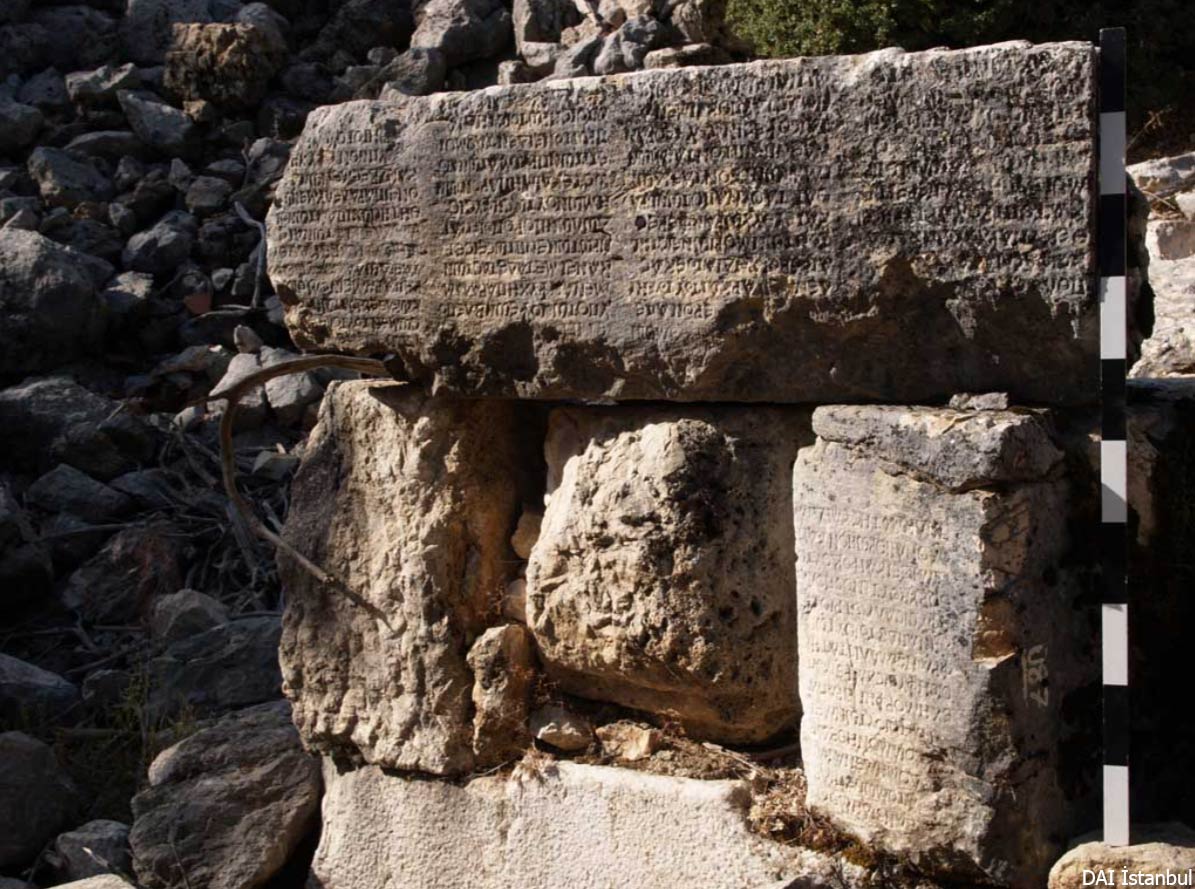
Diogenes Inscription of Oinoanda
This inscription preserves the teachings of the Epicurean philosopher Diogenes, who lived in Oinoanda. It was inscribed on the rear wall of a stoa situated to the south of the Hellenistic agora, within the monumental square known as the “esplanade,” a term introduced by the French research team working at the site in the late 19th century. The inscription is estimated to have extended over a surface approximately 60 meters in length and 3.65 meters in height, making it the longest known ancient Greek inscription carved on stone. It is understood that the inscription was destroyed in the 4th century CE, and parts of it were subsequently reused as spolia in later structures. To date, more than 300 fragments have been recovered. The text represents a monumental copy of the teachings of Diogenes, which are also known from papyrus texts discovered at Herculaneum near Naples.




References:
Bachmann, M. 2016. “Oinoanda: Diogenes’in Şehrindeki Araştırmalar,” Colliquium Anatolicum 15, 294–315.
Bachmann, M. 2016. “Northern Lycia: Oinoanda, Balboura, Elmalı,” in From Lukka to Lycia: The Land of Sarpedon and St. Nicholas, eds. H. İşkan & E. Dündar, 350–361, İstanbul.
Coulton, J. J. 1983. “The Buildings of Oinoanda,” Proceedings of the Cambridge Philological Society 209, 1–20.
Çevik, N. 2021. Lykia Kitabı: Arkeolojisi, Tarihi ve Kültürüyle Batı Antalya, Türk Tarih Kurumu, Ankara.
Images:
J. J. Coulton, 1983
Procopius, 2010.
Odoxo, 2012.
Bora Bilgin, 2022
Tayfun Bilgin, 2022
Reha Özer, 2022